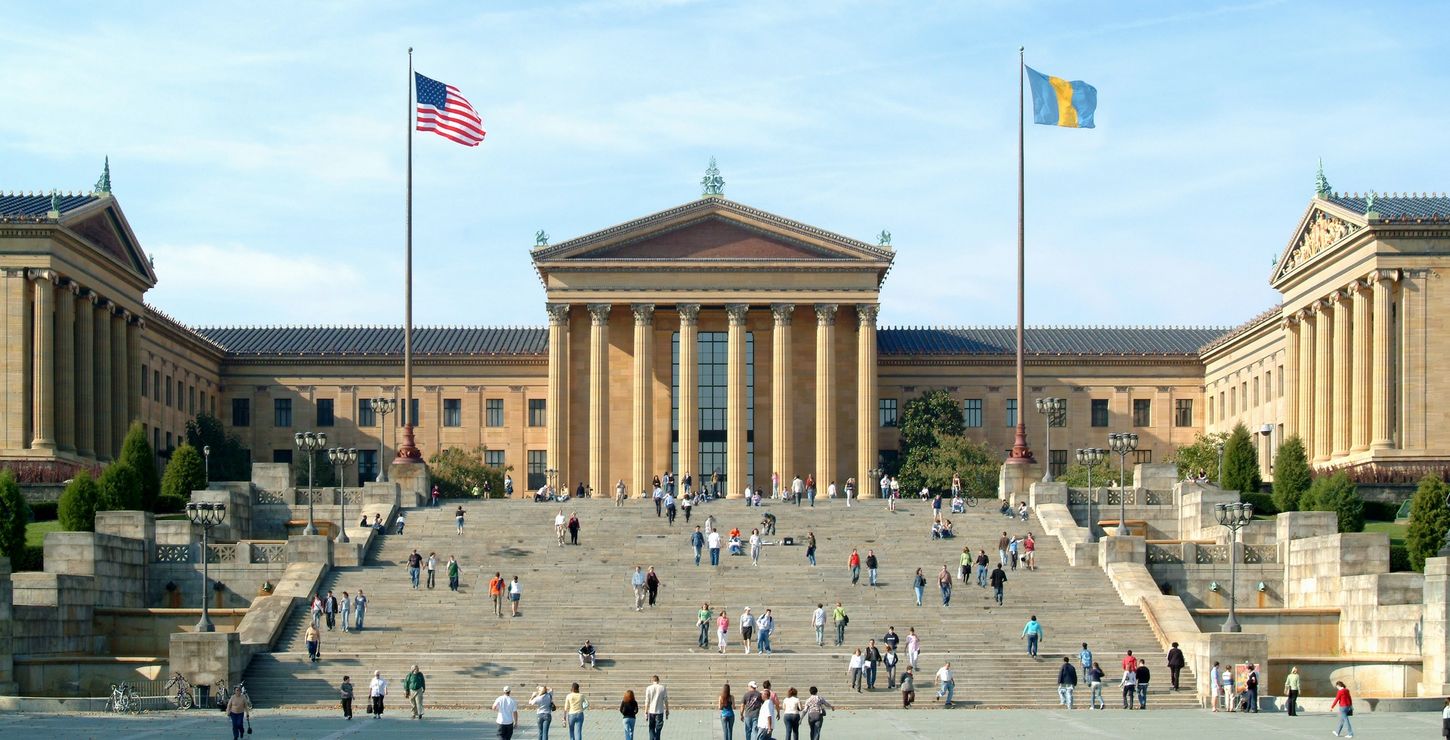
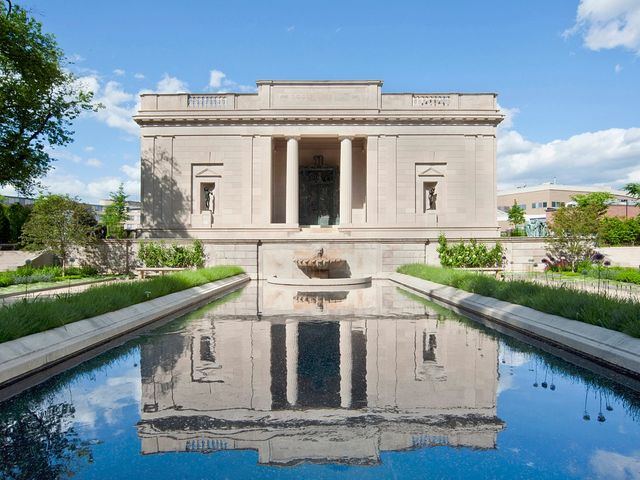
The Philadelphia Museum of Art’s commitment to diversity is evident in its vast collections. In fact, a visit to the Museum is in many ways a journey around the world; with the enlightenment and inspiration of discovering new cultures all under one roof.
East Asian Art
The original architectural installations in the Museum’s East Asian collection are a unique and important part of the collections. These include a Ceremonial Teahouse and fourteenth-century Buddhist Temple from Japan, and a Ch’ing dynasty Scholar’s Study, the Ming dynasty Reception Hall from the palace of Duke Zhao, and a Ming dynasty ceiling from the Buddhist Temple of Wisdom, from China. The galleries also include exquisite ceramics, paintings, lacquer wares, cloisonné pieces, furniture, and stone, wood, and bronze sculptures, as well as an impressive collection of Korean art.
Southeast Asian Art
Stone and bronze sculptures from Thailand and Cambodia are among the stunning works on view in the Museum’s South East Asian Galleries. Examples of ceramics, painting, metalwork, and furniture from Cambodia, Vietnam, Thailand, and Indonesia are also displayed.
Art Of India and Pakistan
The pillared temple hall built into the Museum’s Asian Art wing consists of large granite blocks carved with monumental images of deities, heroes, and scenes from Hindu mythology. The pieces come from temple halls that once stood in the city of Madura, Tamil Nadu, near India’s southern tip. It leads into the Museum’s rich and varied galleries of art from the South-Asian subcontinent—delicate paintings, architectural sculpture in stone and wood, metal images, and sumptuous decorative objects from India and Pakistan.
Himalayan Art
Serene and meditative or vigorous and wrathful, the Buddhist and Hindu arts of Nepal and Tibet embody all opposites. The Museum’s galleries of Himalayan Art display a variety of metal sculptures featuring gods, sages, and protectors, as well as painted hanging scrolls and ritual objects of many materials.
Islamic Art
The painted wood ceiling and stained glass panels ornamenting a cubiculum from the Safavid Emperor Shah Abbas’ Garden Pavilion creates a jewel-like setting for a stunning display of Persian miniature paintings. Stucco fragments excavated from a Sasanian palace at Rayy, in Iran, have been incorporated into the reconstruction of a barrel-vaulted palace hall. Persian mosaic tiles, Turkish ceramics from the famous kilns of Iznik, and Turkish and Persian carpets make up an important part of the Museum’s collections of Islamic art.
Western European Art
The Museum’s collection of Old Masters and Renaissance paintings, from England, France, Italy, and Spain, as well as its collection of Dutch masters, is rich, varied, and extensive. Impressionist and Post-Impressionist masterpieces by Vincent van Gogh, Claude Monet, Henri Matisse, Paul Cézanne, and others, as well as Cubist works by Pablo Picasso and Georges Braque, abound—along with a world-renowned collection of art by Marcel Duchamp.
German And Eastern European Art
The Museum’s outstanding collection of Arms and Armor is notably strong in objects of Germanic origin from Saxony, Brunswick, Augsburg, Bavaria, Austria, Liechtenstein, and the Tirol. Significant art works from Germany in the Museum’s collections include a fifteenth-century silver and gold reliquary, a seventeenth-century wool carpet made in the southern Caucasus, and examples of porcelain from the important eighteenth-century German factories of Meissen, Fürstenberg, Frankenthal and Höchst. Paintings and sculpture from the region include works by Karl Friedrich Lessing, Eduard Charlemont, Franz Marc, Paul Klee, Lyonel Feininger, Max Beckmann, Gerhard Richter, Anselm Keifer and Katharina Fritsch; as well as Russian artist Wassily Kandinsky—who helped found Munich’s Blue Rider school of Expressionism. In addition, the Museum has an extensive collection of sculpture by Romanian-born Constantin Brancusi.
African Art
A very small number of objects, sculpture, and costumes and textiles comprise a growing collection of art from the African continent. Donations for the Museum’s fall 1997 exhibition Best Dressed: 250 Years of Style included two native Ile Ife Nigerian costumes and a Bambara man’s outfit from the Ivory Coast.
Mexican Art
Pre-Colombian objects, including two large Aztec stone sculptures, comprise some of the oldest objects in the Museum’s collection. Mexican Colonial Art has its own gallery, and includes religious paintings and portraits along with Talavera pottery made in Puebla during the eighteenth century. Frescos, prints, photographs, and regional embroidered dress and textiles are among other outstanding examples of the Museum’s Mexican art.